
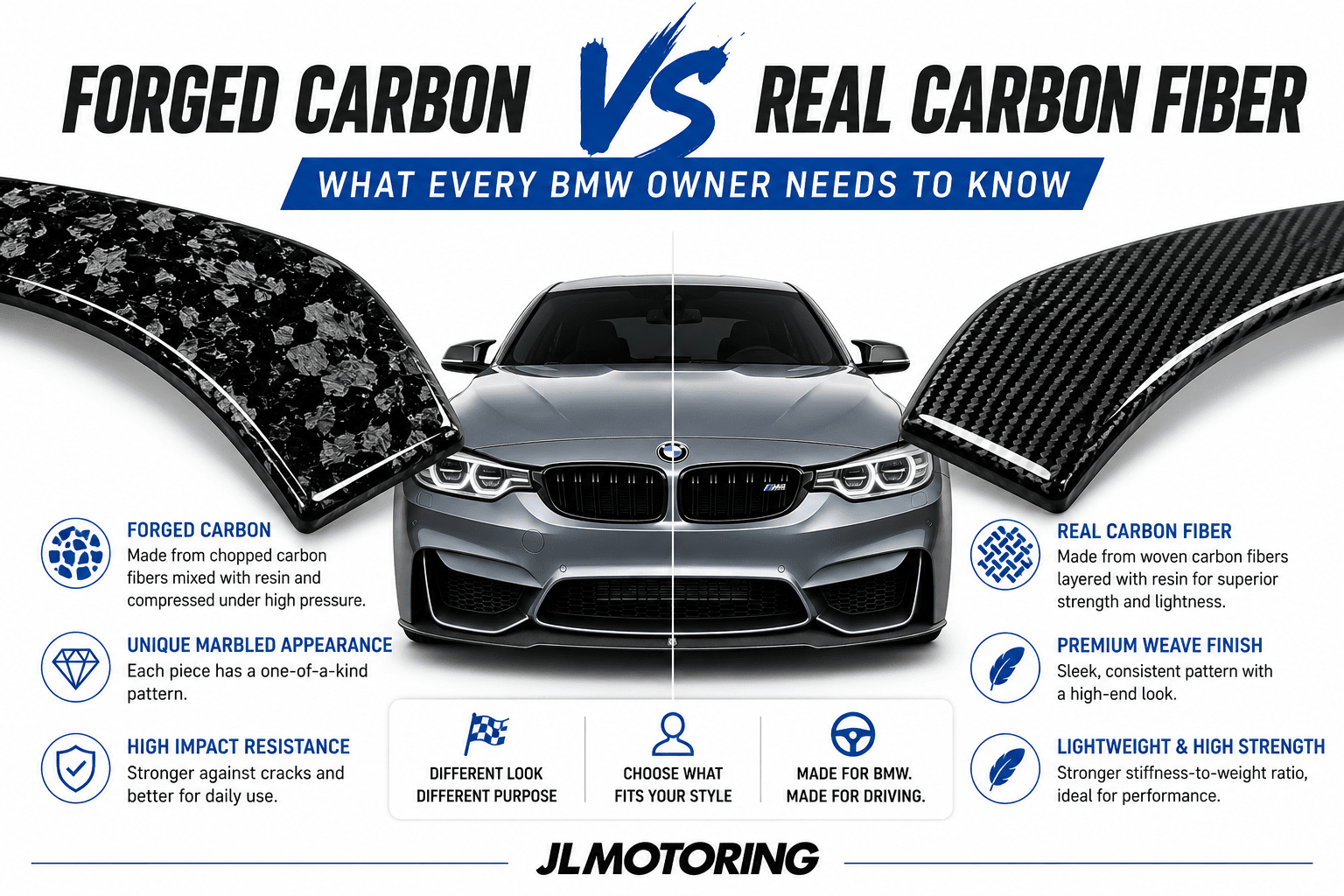
You've decided to upgrade your BMW with carbon fiber. Now comes the harder question: which kind?
Walk through any BMW forum or shop page and you'll see two terms thrown around — "carbon fiber" and "forged carbon." They sound similar. They're both lightweight. They're both premium. But they are genuinely different materials with different looks, different strengths, and different ideal use cases.
This guide cuts through the marketing noise and tells you exactly what you're getting with each material — so when you're choosing a front lip, diffuser, or trunk spoiler for your G87 M2, G80 M3, or F80 M3, you can pick with confidence.
What Is Traditional Carbon Fiber?
Traditional carbon fiber — what most people mean when they say "carbon fiber" — is made by weaving continuous carbon strands into a fabric, then saturating that fabric with epoxy resin and curing it under heat and pressure. The most common weave pattern in automotive parts is the 2×2 twill weave: that instantly recognizable diagonal checkerboard you see on OEM BMW M Performance parts and virtually every quality aftermarket piece.
The continuous, interlocked fiber strands are what give woven carbon its exceptional tensile strength. The fibers bear load along their full length without interruption. This is why aerospace and motorsport applications — where parts must handle sustained directional forces — almost always specify woven carbon fiber.
For BMW owners, 2×2 twill carbon has another major advantage: it matches the factory look exactly. BMW's own M Performance carbon parts, the CSL hood, the M4 CSL front splitter — all 2×2 twill. If visual consistency with OEM components matters to you, woven carbon is the obvious choice.
Key characteristics:
- Continuous woven carbon strand construction
- Classic 2×2 twill pattern — same as OEM BMW M Performance parts
- Highest tensile strength of any carbon composite
- Consistent, repeatable appearance across parts
- Premium cost (typically 20–30% more than comparable FRP parts)
What Is Forged Carbon?
Forged carbon was invented in the mid-2000s through a collaboration between Lamborghini and the Callaway Golf Company. Lamborghini was trying to reduce composite production costs while increasing output — and what they developed turned out to have its own unique aesthetic that made it desirable in its own right.
Instead of weaving continuous strands, forged carbon is made by chopping carbon fiber into short pieces, mixing them with resin, then compressing the mixture under high heat and pressure into a mold. The result is a part where the carbon fragments are randomly oriented throughout the material.
The key visual consequence of this process: every single forged carbon piece looks different. The random orientation of the carbon fragments creates a marbled, almost stone-like pattern — never uniform, never repeating. It's genuinely unique to each part. For some BMW owners that's a major selling point; it guarantees your car's carbon pieces won't look identical to anyone else's.
Key characteristics:
- Chopped carbon fiber compressed under heat and pressure
- Unique marbled pattern — no two pieces identical
- Excellent impact resistance and toughness
- Slightly heavier than comparable woven carbon parts
- Premium cost — typically 40–50% more than standard FRP, and above most woven carbon parts
Side-by-Side Comparison
| Traditional Carbon Fiber | Forged Carbon | |
|---|---|---|
| Manufacturing | Woven continuous strands + resin | Chopped carbon + resin, heat-compressed |
| Pattern | Consistent 2×2 twill weave | Unique marbled pattern, never repeats |
| Tensile strength | Higher | Moderate |
| Impact resistance | Moderate (can crack under sharp impact) | Higher (more flexible under sudden force) |
| Weight | Very light | Slightly heavier than woven |
| OEM look match | ✅ Yes — matches BMW M Performance parts | ❌ No — distinctive, contrasting look |
| Price | Premium | Higher premium |
| Best for | Track builds, OEM+ aesthetic, mixed builds | Show cars, statement builds, unique looks |
Which Is Stronger?
This is the question we get most often, and the honest answer is: it depends on what kind of stress you mean.
Traditional woven carbon fiber has higher tensile strength — its continuous strands handle pulling and flexing forces better. If a part needs to withstand sustained aerodynamic load at speed, woven carbon is the superior choice.
Forged carbon, on the other hand, has better impact resistance and toughness. The randomly-oriented, chopped strands actually distribute sudden point-impact forces better than woven carbon, which can crack or delaminate when struck sharply. If you're worried about rock chips, minor debris impact, or the occasional parking lot nudge, forged carbon may hold up better day-to-day.
For exterior styling pieces on a street car — front lips, diffusers, side skirts, trunk spoilers — this distinction rarely matters in practice. Both materials are massively stronger than the OEM plastic and FRP parts they replace. The structural question becomes relevant mainly if you're tracking the car hard and running aero under significant downforce load.
How to Choose for Your BMW
Go with traditional carbon fiber if:
- You want your aftermarket parts to blend with any OEM M Performance carbon already on the car
- You're building a clean, factory-plus look (common on G80 M3 and G87 M2 track builds)
- You have multiple carbon pieces and want visual consistency across the car
- You're running the car at track days where aerodynamic load is a real factor
- You prefer a timeless look that won't polarize opinions at car meets
Go with forged carbon if:
- You want your car to stand out immediately — the marbled pattern reads differently at a glance than standard carbon
- You're building a show car or a "statement" build and want a premium detail that no one else has
- You already have woven carbon pieces and want to use forged carbon as a contrast accent (e.g., a forged carbon mirror cap against woven carbon hood accents)
- You want a talking point — the history and rarity of forged carbon genuinely impresses people who know it
The hybrid approach
A growing number of serious BMW builds actually use both materials intentionally. Woven 2×2 carbon on larger structural and visible panels (hood, trunk, splitter, diffuser) keeps the OEM-cohesive look intact. Forged carbon on smaller accent pieces — mirror caps, interior trim, shift paddles — introduces a premium contrast detail without overwhelming the overall aesthetic.
What to Look for When Buying
Regardless of which material you choose, the same quality markers apply:
For woven carbon fiber:
- Tight, uniform 2×2 twill weave with no skipped or misaligned strands
- Smooth clear coat with no orange peel or hazing
- Consistent weave direction across the entire piece
- Clean edges with no exposed raw fiber
For forged carbon:
- Dense, even distribution of carbon fragments throughout (no thin spots or resin-heavy areas)
- Deep gloss clear coat that lets the pattern depth show
- Uniform compression — the surface should feel solid, with no soft spots
In either case, always ask about the manufacturing process. High-quality carbon parts use pre-impregnated (prepreg) carbon or vacuum-infused wet layup, which removes excess resin and produces a lighter, stiffer part. Cheaper parts skip these steps, resulting in heavier and weaker panels.
JL Motoring Carbon Fiber Parts for BMW
At JL Motoring, we carry both traditional carbon fiber and forged carbon parts specifically fitment-tested for G87 M2, G80/G81 M3, F80 M3, and other BMW M chassis. Every piece is inspected for weave quality, clear coat finish, and panel fitment before it ships.
Whether you're building a clean OEM+ street car or a statement show build, our catalog has the pieces to do it right.
→ Shop Carbon Fiber Parts for G87 M2
→ Shop Carbon Fiber Parts for G80/G81 M3
→ Shop Carbon Fiber Parts for F80 M3
→ View All Carbon Fiber Exterior Parts
Frequently Asked Questions
Is forged carbon actually carbon fiber?
Yes. Forged carbon is made from real carbon fiber — the difference is that the carbon strands are chopped rather than woven. Both materials contain genuine carbon fiber reinforced with epoxy resin. "Fake carbon fiber" — sometimes called carbon fiber vinyl or ABS with a carbon-print overlay — is a completely different (and inferior) product.
Is forged carbon heavier than regular carbon fiber?
Slightly, yes. Because chopped-strand construction is less efficient at load-bearing than continuous woven strands, forged carbon parts typically require slightly more material to achieve equivalent stiffness, making them marginally heavier. For exterior styling pieces the difference is negligible in practice.
Can you mix forged carbon and woven carbon on the same car?
Absolutely — and many high-end builds do exactly this. The key is using forged carbon intentionally as an accent material rather than randomly mixing pieces. A consistent approach (e.g., forged carbon on all small accent pieces, woven carbon on all large panels) looks deliberate and purposeful.
Does forged carbon fade or yellow over time?
Like any carbon fiber, forged carbon's clear coat can yellow or dull over time with UV exposure if not maintained. Regular waxing or ceramic coating protects the finish. High-quality parts use UV-resistant clear coats that significantly slow this process.
Which material is better for track use?
Traditional woven carbon fiber, generally speaking. Its higher tensile strength is better suited for sustained aerodynamic loads at speed. That said, for street-driven M cars, both materials perform more than adequately in exterior styling applications.
Written by the JL Motoring team. We specialize in carbon fiber exterior upgrades for BMW M vehicles, with fitment-tested parts for G87 M2, G80 M3, F80 M3, and more.

Share:
BMW Chassis Code Guide: Complete List of E, F, and G Series (With Model Years)
BMW Bumper Upgrades: M Sport vs. M3/M4/M5 Style — Complete Guide by Chassis